


Ahmedabad: Gautam Shantilal Adani, founder and chairman of the Adani Group, celebrates his 64th birthday today, marking another milestone in the career of one of India’s most influential — and closely watched — business figures.
Born on June 24, 1962, in Ahmedabad, Adani built a conglomerate that now spans ports, power, airports, renewables, cement, data centres, defence, roads, rail, media, real estate, FMCG and digital platforms. In corporate India, that is less a business portfolio and more a very ambitious spreadsheet with national infrastructure written across the top.
The Adani Group describes itself as India’s largest integrated infrastructure group, with a combined market capitalisation of more than $150 billion across twelve publicly traded companies. Its businesses follow the group’s stated philosophy of “Nation Building” and “Growth with Goodness,” while investors often see it as a proxy for India’s infrastructure expansion story.
Adani is among India’s richest industrialists. Forbes reported earlier this month that his net worth had risen to about $89.2 billion, helping him regain the title of Asia’s richest person. Wealth rankings, of course, move with the market; billionaire lists can be less stable than Mumbai traffic during monsoon, but Adani’s position remains central to India’s corporate landscape.
His journey began far from boardrooms and mega-projects. As a teenager, Adani moved to Mumbai in 1978 and worked as a diamond sorter. In 1981, he returned to Ahmedabad to manage his elder brother’s plastics unit, a move that introduced him to global trading through polyvinyl chloride imports.
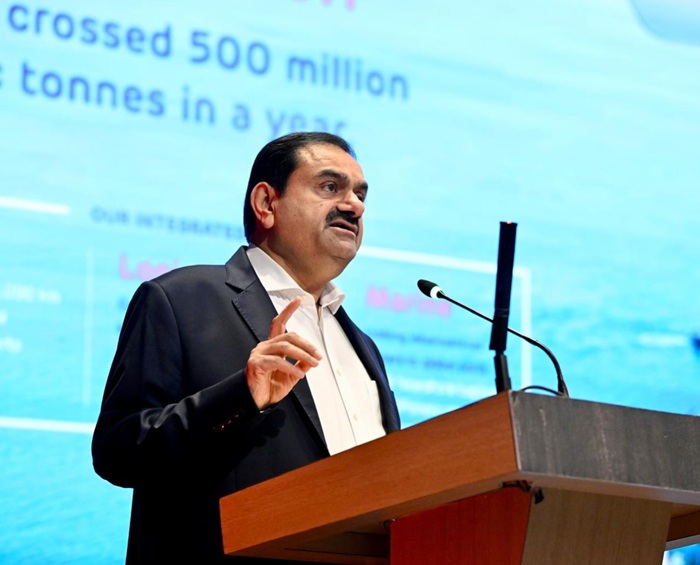
In 1988, he founded Adani Exports, now Adani Enterprises, which started in commodity trading before expanding into metals, textiles and agro products. Economic liberalisation in the 1990s gave the company a larger runway, and Adani used it to move aggressively into infrastructure.
The turning point came with Mundra Port in Gujarat. After obtaining the contract in the 1990s, Adani developed what became India’s largest private-sector port. From there, the group widened its footprint into power generation, transmission, renewable energy, airports, city gas distribution and logistics.
Adani Power was founded in 1996 and became one of India’s major private power producers. The group later entered renewable energy in a big way, with Adani Green Energy becoming a key player in solar and wind power. Adani has also committed large investments to support India’s green energy transition, including a stated $70 billion plan.
The conglomerate’s expansion has not stopped at infrastructure. In 2022, the Adani family acquired Ambuja Cements and ACC from Holcim in a $10.5 billion deal, instantly making the group one of India’s biggest cement players. Around the same period, Adani’s media arm moved into NDTV, a development that triggered debate over media ownership and editorial independence in India.
Adani has also made major philanthropic commitments. In 2022, on his 60th birthday, the Adani family announced a ₹60,000 crore commitment for healthcare, education and skill development. More recently, the group has highlighted rural healthcare and education initiatives under the Adani Foundation.
But Adani’s rise has also brought intense scrutiny. He has often been described as close to Prime Minister Narendra Modi and the Bharatiya Janata Party government, a relationship that critics have cited while raising allegations of cronyism. The Adani Group has repeatedly rejected such allegations.
In January 2023, Hindenburg Research accused the Adani Group of stock manipulation and accounting fraud, allegations the group strongly denied. In January 2024, the Supreme Court of India declined to transfer the matter to a CBI or SIT investigation, while leaving the market regulator SEBI to continue its work where required.
Adani also faced legal scrutiny in the United States. In November 2024, U.S. prosecutors charged Adani and other executives in a case alleging a bribery and fraud scheme linked to solar contracts. The Adani Group denied wrongdoing. In May 2026, the Trump administration moved to dismiss the criminal fraud charges, while related civil matters were reported as being settled without admission of wrongdoing.
Despite controversies, Adani remains one of the most consequential figures in Indian business. His group’s assets touch daily life in ways many consumers may not immediately notice — from electricity and airports to cooking gas, cement, food products and digital services.
In 2022, Time magazine included Gautam Adani in its list of the 100 most influential people in the world, reflecting his growing global visibility. Today, at 64, he stands at the intersection of India’s infrastructure ambitions, market confidence, political debate and corporate accountability.
For supporters, Adani represents first-generation entrepreneurship at national scale. For critics, his story raises important questions about the concentration of economic power and the relationship between business and government. Either way, Gautam Adani’s 64th birthday is not merely a personal milestone — it is a reminder of how deeply one businessman’s rise has become tied to the larger story of modern India.