


Gwalior: The Department of Telecommunications and the Madhya Pradesh government have signed a Memorandum of Understanding to establish India’s first integrated Telecom Manufacturing Zone in Gwalior, with the Centre committing ₹493 crore to develop infrastructure during the first phase.
The proposed zone is expected to attract investments of up to ₹12,000 crore to ₹15,000 crore over time and generate around 14,000 direct skilled jobs, positioning Gwalior as a major telecom and electronics manufacturing hub in Central India.
The agreement was signed in the presence of Union Minister of Communications and Development of North Eastern Region Jyotiraditya M. Scindia, Madhya Pradesh Chief Minister Mohan Yadav, and Union Minister of State for Communications and Rural Development Chandra Sekhar Pemmasani.
The project is intended to bring manufacturing, research and development, product design, testing, certification and innovation facilities together within a single industrial ecosystem. In industry terms, the idea is to ensure that telecom products travel from the drawing board to the factory floor without collecting too many boarding passes along the way.
Special Purpose Vehicle to Manage Project
The signing of the MoU will lead to the formation of a Special Purpose Vehicle to develop and manage the Telecom Manufacturing Zone. The Madhya Pradesh government will hold a 51 per cent equity stake in the entity, while the Department of Telecommunications will hold the remaining 49 per cent.
The TMZ has been envisaged as a 350-acre plug-and-play industrial cluster for telecom and electronics manufacturers and allied industries.
For the initial development, the Madhya Pradesh government has allocated approximately 170 acres of land free of cost. This includes 100 acres in the Special Area Development Authority region and 70 acres at the Gwalior IT Park, with the land valued at around ₹596 crore.
Additional land will be offered at a nominal premium of ₹1, along with a fixed annual lease rent of ₹1 per square metre for 30 years.
The Centre will provide 100 per cent funding for the first phase’s core infrastructure, with an allocation of ₹493 crore.
Investment Commitments and Employment
The government expects the project to attract initial investment commitments of approximately ₹5,000 crore during Phase-I, followed by total investments of between ₹12,000 crore and ₹15,000 crore as the zone expands.
The project is projected to generate approximately 14,000 direct skilled jobs, including nearly 3,500 positions during the first phase, in addition to tens of thousands of indirect employment opportunities.
At an investor roundtable held after the MoU signing, industry representatives committed investments worth ₹3,500 crore and indicated the potential creation of 14,000 jobs linked to the zone.
Telecom and electronics companies including Dixon Technologies, HFCL, Tejas Networks, VVDN and Syrma SGS are among the industry players expected to anchor the proposed manufacturing cluster.
Incentives for Telecom Manufacturers
The Madhya Pradesh government has announced a special incentive package for companies setting up manufacturing and research facilities within the TMZ.
Eligible businesses will be able to receive a capital subsidy covering 50 per cent of Eligible Fixed Capital Investment, subject to a maximum benefit of ₹200 crore.
Eligible mega projects may also receive employment generation assistance of ₹5,000 per employee per month for five years. Skill-development support of up to ₹13,000 for every new employee will be available, subject to applicable conditions.
Other incentives include reimbursement of stamp duty and registration charges, power tariff rebates and fiscal support for research, patents and intellectual property protection.
To encourage exports, eligible units will receive a 50 per cent freight subsidy on finished products transported to seaports or air-cargo facilities, within prescribed limits.
The policy package also provides reimbursement support for standalone research and development units and 100 per cent reimbursement of eligible expenses incurred while filing patents, copyrights and trademarks.
Focus on Indigenous Telecom Products
The proposed zone will cover a wide range of telecom and electronics products, including mobile devices, routers, antennas, optical fibre, semiconductor technologies and equipment required for future 5G and 6G networks.
Dedicated research centres, common testing laboratories and certification facilities are planned to help companies develop and validate telecom products according to global standards.
The project will also seek alignment with national initiatives such as the India Semiconductor Mission, the Electronics Components Manufacturing Scheme and the Telecom Technology Development Fund.
Officials said the zone would support domestic manufacturing of critical telecom components, reduce dependence on imported equipment, strengthen local supply chains, promote exports and improve security within India’s telecommunications infrastructure.
India Must Become a Telecom Manufacturer: Scindia
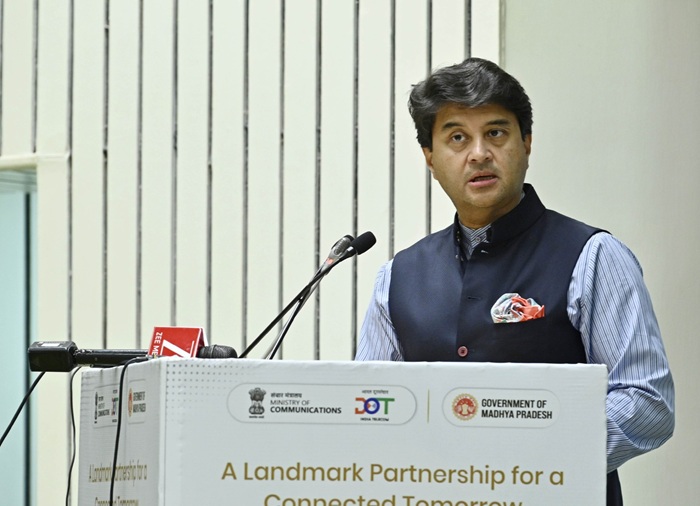
Speaking at the event, Union Minister Jyotiraditya Madhavrao Scindia said, “India’s first Telecom Manufacturing Zone will be established in Gwalior, the heart of the country, and will accelerate Madhya Pradesh’s growth trajectory.”
He described the project as a milestone in advancing the government’s Aatmanirbhar Bharat, Make in India, Digital India and Viksit Bharat 2047 programmes.
The minister said the project would strengthen India’s presence on the global telecom manufacturing map and credited the Madhya Pradesh government’s development policies under Chief Minister Mohan Yadav.
Scindia also said, “India must now move beyond being a telecom service provider to becoming a telecom manufacturer, and that building a strong indigenous ecosystem is essential to achieving this goal. The Telecom Manufacturing Zone is a major step in that direction.”
The minister said the government’s role would be that of a partner and facilitator for investors rather than merely an administrative authority.
Gwalior Expected to Emerge as Electronics Hub
Chief Minister Mohan Yadav credited Scindia’s efforts for the project and said, “ The Telecom Manufacturing Zone (TMZ) is the outcome of Union Minister Jyotiraditya Scindia’s sustained efforts and visionary leadership.”
Yadav said the development represented a new chapter in Gwalior’s industrial growth and expressed confidence that it would influence the technological and manufacturing future of both Madhya Pradesh and India.
“What cannot be found anywhere else in India will now be available in Madhya Pradesh,” he said.
The chief minister said Gwalior was set to become a national centre for electronics and telecom manufacturing, supported by investment, employment and technological innovation.
Union Minister of State Chandra Sekhar Pemmasani described the agreement as a historic development for the Department of Telecommunications and the Madhya Pradesh government.
“It is a historic day for both Department of Telecommunications and Government of Madhya Pradesh for establishing first of its kind similar to a SEZ where you put everything from end to end whether it is research, manpower, design, testing and manufacturing in one area. We want to design, patents and intellectual property rights and globally competitive products and this manufacturing zone will help in achieving that,” he said.
Investor Roundtable Held After MoU Signing
An investor roundtable was subsequently held under the joint chairmanship of Scindia, Yadav and Pemmasani.
Telecom manufacturers and other industry stakeholders discussed investment opportunities, infrastructure requirements and the potential role of the Gwalior zone in strengthening India’s manufacturing capabilities.
Industry representatives welcomed the policy incentives and land package announced by the Centre and the state government, while highlighting the importance of common testing, certification, research and skill-development facilities.
The project reflects India’s broader effort to move beyond being one of the world’s largest telecom service markets and build a stronger domestic manufacturing base. Its long-term significance, however, will depend on how quickly investment commitments translate into factories, research centres, supply chains and skilled employment on the ground.
If implemented as planned, the Gwalior Telecom Manufacturing Zone could give Central India a prominent place in the global telecom industry—and turn the region from a consumer of communications technology into a place where much of that technology is designed, tested and built.